
Key Takeaways
What agentic AI actually is — An agent carries out multi-step work, then brings you the result to approve.
The busywork ledger — Agents take the coordination work. Every judgment call stays with you.
The judgment stays human (and so does the accountability) — Accountability doesn't transfer to software. An agent is only as trustworthy as the payroll engine underneath it.
What this means for your role — The role shifts from proving every number by hand to defining what correct looks like.
Five questions to ask your vendor — These five apply to the system you run today as much as anything on the market.
Where we're headed — The compliance engine came first. The AI is being built on top of it, not the other way around.
AI has arrived in payroll software. New features are landing in the systems teams already run, vendors are announcing more, and leadership is starting to ask questions. Somewhere in all of this, every payroll professional is doing the same quiet math: what does this mean for my team?
It's a fair question, and it deserves a better answer than a buzzword. Here's the honest version: a lot of what gets said about AI in payroll is hype. The real shift is narrower and more useful. AI is starting to take on the parts of the job that were never really the job, the chasing and re-keying and manual workarounds that eat up payroll week. The judgment stays where it always was. Knowing the difference is becoming a core payroll skill, because whether your current system adds AI features or a new one promises them, you'll be the one deciding how much to trust.
In this guide:
- What agentic AI actually is, and what it isn't
- The busywork ledger: what agents take, what stays yours
- Why judgment and accountability stays with you
- What this means for your role
- The five questions to ask any vendor about AI
- Where this is all headed
What agentic AI actually is

An agent carries out multi-step work, then brings you the result to approve.
Most AI you've met so far answers questions. You ask, it responds: a chatbot with better manners. Agentic AI is a different animal: it carries out multi-step work toward an outcome, then brings you the result to approve.
Take timesheet exceptions. A chatbot can tell you which timesheets are missing. An agent finds the exceptions, messages the managers, follows up with the ones who haven't responded, and hands you a resolved list before cutoff, with a record of every step it took.
In payroll terms, agents point toward work like:
- Exception chasing. Finding missing or flagged timesheets and running the follow-ups, so approvals arrive before deadline day.
- Remittance preparation. Assembling the package, checking amounts against thresholds and due dates, and queueing it for your review.
- Pre-run anomaly checks. Comparing this run against history and flagging the doubled deduction or missed retro before it reaches employees.
- Routine documents. Drafting a Record of Employment (ROE) from data already in the system, ready for your review and submission.
The key mechanic in every case: a person sets the rules, and a person approves the output. The agent does the legwork in between. If a system offers AI with no clear human approval point, that isn't automation, it's abdication.
The busywork ledger
Agents take the coordination work. Every judgment call stays with you.
If payroll week runs three or four days at your organization, it's worth auditing where the time actually goes. Rarely is it the judgment calls. It's the coordination: the follow-ups, the re-keying between systems that don't talk to each other, the workaround only one person knows how to run, the spreadsheet audit trail you built yourself because the system wouldn't.
That's the busywork ledger, and it splits cleanly.
What agents can take:
- Chasing approvals and missing data
- Re-keying between HR, time, and payroll systems
- Assembling remittance and reporting packages
- First-pass anomaly and variance checks
- Drafting routine documents and responses
- Answering the recurring employee questions—the "where's my T4" emails
What stays yours:
- Compliance judgment and interpretation
- Collective agreement application—the clause that doesn't fit the rule engine
- The edge cases, and the exceptions to the exceptions
- Final sign-off and accountability
- Process design: deciding what "correct" means in your organization
- Deciding which vendors and tools deserve your trust
Notice the pattern: everything in the first list is work that happens before your judgment. Everything in the second list is your judgment.
The judgment stays human—and so does the accountability
Accountability doesn't transfer to software. An agent is only as trustworthy as the payroll engine underneath it.
There's no version of this where accountability transfers to software. When the Canada Revenue Agency has questions, "the AI did it" is not a sufficient response. Someone still signs off on every run, and that someone is you.
Which leads to the caveat payroll professionals will appreciate more than most: an agent is only as trustworthy as the payroll engine underneath it. An agent operating on a system that treats Canadian compliance as a regional add-on will automate the wrong thing with complete confidence. Faster wrong answers, at scale. Multi-province rules, union dues, retro pay across a collective agreement: none of it is something AI can improvise on top of a platform that never handled it properly in the first place.
CRA rules change twice a year, on schedule. Provincial legislation changes on no schedule at all. Before asking whether an agent can keep up, ask whether the engine it runs on ever could.
What this means for your role
The role shifts from proving every number by hand to defining what correct looks like.
A third of National Payroll Institute members hold strategic or managerial roles, according to NPI's 2023 member census.
When the coordination work compresses, what's left is the work leadership actually sees: the true cost of payroll, the process design, the reporting finance and HR can both trust. The payroll professional's job shifts from proving every number by hand to defining what correct looks like, then verifying the system delivers it.
The skills that grow in value are the ones this profession already respects: process judgment, data literacy, and the confidence to interrogate a vendor until the buzzwords run out.
Five questions to ask your vendor about AI capabilities
Whether it's your current vendor's release notes or a product you're evaluating, these five questions will tell you most of what you need to know:
- Where does a human approve? If there's no clear approval point, it's automation without accountability. The bar should scale with reversibility: the harder a mistake is to unwind after payday, the earlier a person belongs in the loop.
- What happens when CRA rules change? Legislative updates twice a year are table stakes. Who updates the agent's behaviour, and how quickly?
- Is Canadian compliance native or configured? Ask where the payroll engine was built and for whom. Compliance developed for Canada from day one behaves differently than a global product with a Canadian layer configured on top.
- What's the audit trail? Every action an agent takes should be logged and reviewable. If you can't reconstruct it, you can't defend it.
- Where does the data live? Payroll data is some of the most sensitive information your organization holds. It should stay in Canada.
If the answers don't come back in plain English, the marketing is doing more work than the product.
Common questions about AI in payroll
What is agentic AI in payroll?
AI that carries out multi-step payroll work, like chasing timesheet exceptions or assembling a remittance package, then brings the result to a person for approval. It acts within rules your team sets. A chatbot answers questions; an agent does legwork.
Will AI replace payroll professionals?
No. It's positioned to take on the coordination work: follow-ups, re-keying, first-pass checks. Compliance interpretation, collective agreement judgment, and final sign-off stay with people, and so does accountability.
Is agentic AI safe for Canadian payroll?
That depends on the engine underneath it. An agent inherits the compliance depth of the system it runs on, so multi-province rules, union dues, and CRA changes need to be native to the platform, not configured after the fact. The five questions above are how you check.
Where we're headed
The compliance engine came first. The AI is being built on top of it, not the other way around.
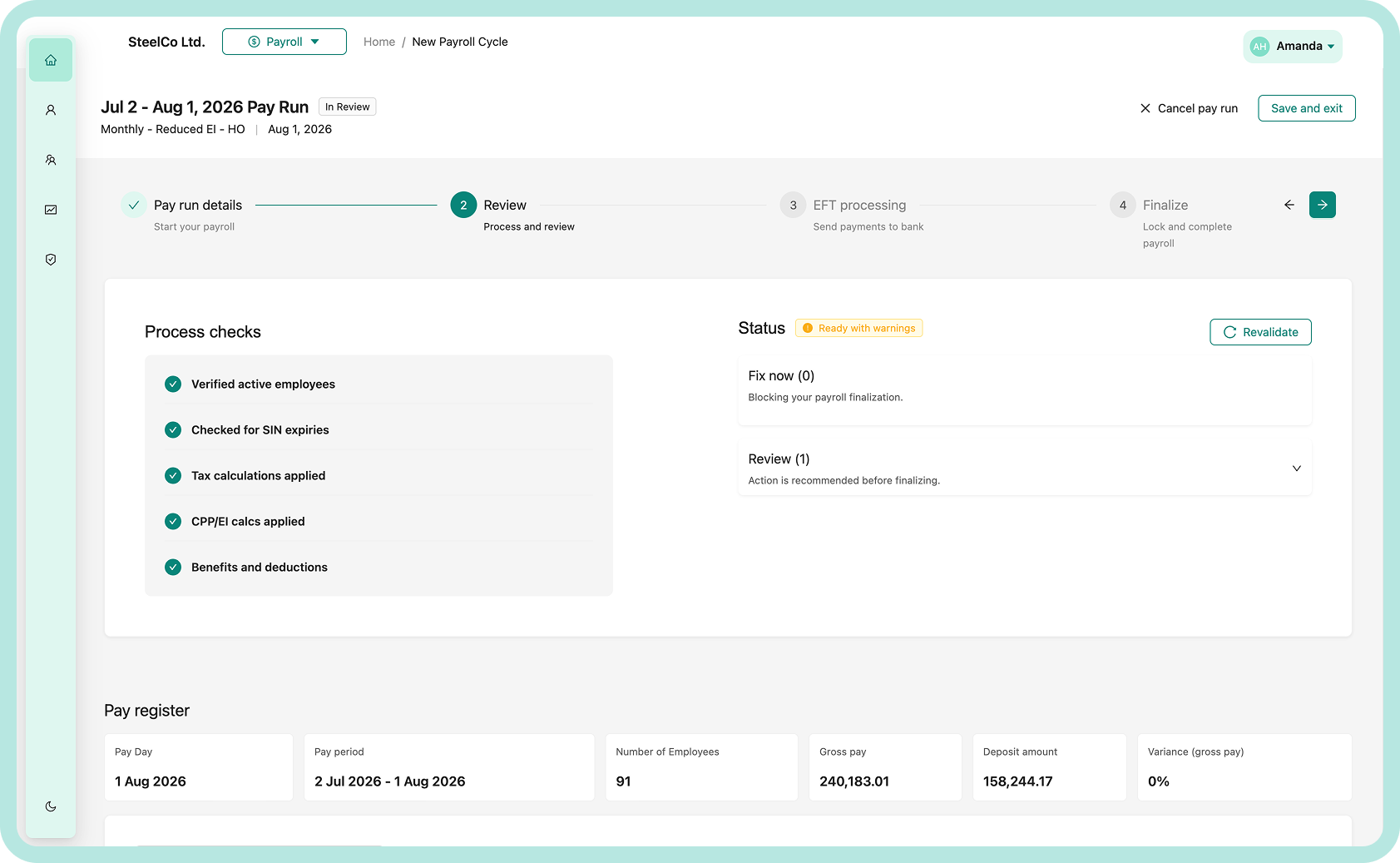
Avanti has spent 40+ years building payroll software exclusively for Canada, with CRA and provincial compliance built in from day one, not bolted on. The new Avanti is all of that expertise, rebuilt as a modern, easy-to-use cloud solution, with an AI layer on top. Lots of it is working today: anomaly checks that flag irregularities before a run is processed, and Ava, Avanti's AI assistant, answering routine payroll and policy questions on demand. The multi-step agentic legwork this guide describes is where Ava is headed: handling the repetitive so your team can handle the complex.
A concrete example of what's here now: Ava can reference the payroll knowledge you upload (collective agreements, overtime policies, pay calendars), so when someone asks how banked time pays out under your agreement, the answer comes from your documents rather than a guess.
And every answer Ava gives cites its source, so you have an audit trail and a way to verify it yourself.
Get paid to see the brand new Avanti
Book a 30-minute demo of the new Avanti and walk away with a $100 digital gift card.
Get paid to see the brand new Avanti
Book a 30-minute demo of the new Avanti and walk away with a $100 digital gift card.