
Key Takeaways
- Manual recruiting drains resources: Outdated tools force HR teams to spend hours on repetitive tasks like posting jobs, screening resumes, and tracking candidates across spreadsheets and email.
- Poor screening wastes time: Without role-specific knockout questions, teams sift through unqualified applicants instead of focusing on top talent, increasing mis-hire risk.
- Limited reach hurts competitiveness: SMBs without integrated job board connections struggle to attract qualified candidates and compete with larger employers.
- Modern ATS cuts time-to-hire by 30-50%: Automation eliminates manual posting, screening, and scheduling, saving 10+ hours per hire and reducing vacancy costs.
- Cost-per-hire drops 20-40%: Automated workflows reduce paid job board spend, minimize external recruiter fees, and cut wasted interview time.
- Quality improvements reduce turnover: Structured screening and evaluation prevent mis-hires that cost 1-1.5x annual salary to replace.
- HR reclaims 100-300 hours annually: Automation frees teams to focus on strategic work like retention, engagement, and DEI initiatives.
- Better candidate experience drives acceptance: Fast, professional hiring processes help SMBs compete for top talent and improve offer acceptance rates.
If you’ve ever had to open 27 tabs just to get through one hiring cycle, this post is for you.
For many HR teams—especially in small and mid-sized organizations across Canada—recruiting can feel like a constant uphill climb. You’re expected to compete in a tight labour market, support hiring managers, and manage the entire candidate experience, all while juggling everything else HR is responsible for.
And yet, a surprising number of teams are doing all of that with tools that haven’t kept up. Maybe it’s a legacy ATS that hasn’t been updated in years. Maybe it’s a patchwork of spreadsheets and email folders. Maybe your ‘workflow’ is a mix of sticky notes, inbox searches, and good intentions.
Whatever the case, old systems come with hidden costs that drain time, money, energy, and candidate goodwill. Let’s break down what those costs look like and what you can do to fix them.
The top hiring challenges for SMBs (and why outdated applicant tracking systems make them worse)
The reality is this: recruiting is more than filling seats. It’s a strategic function that fuels growth, shapes culture, and influences performance across the entire organization.
But HR teams at small and mid-sized organizations face some consistent hurdles, many of which stem from outdated or inadequate recruiting tools.
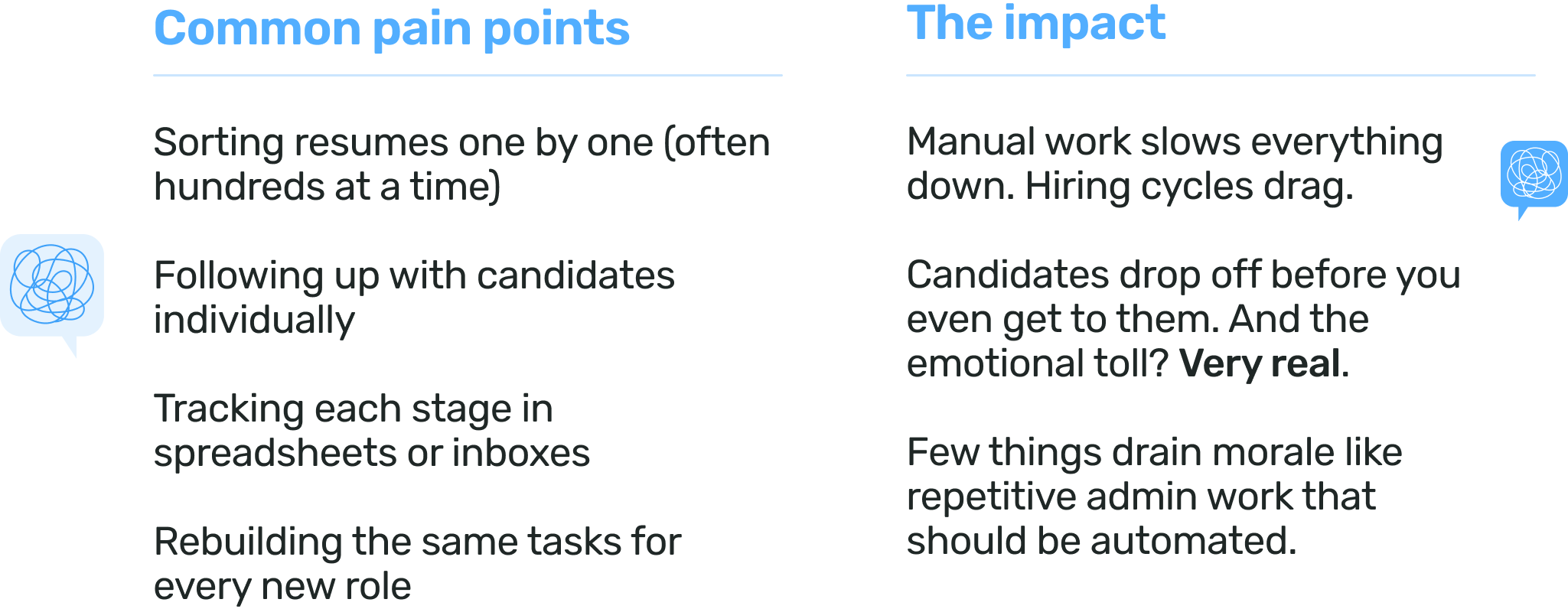
1. Your manual workload is out of control
You post jobs manually. You track candidates manually. You move applicants between stages manually. You send emails manually. You remove duplicates manually. You—well, you get it. Even the most organized HR team ends up stretched thin. Rest assured, if this sounds familiar, you’re not alone.
For many HR teams, recruiting still feels like a scavenger hunt—resumes in the inbox, notes in a spreadsheet, candidate questions buried somewhere in Teams or Slack. It’s not that the process is broken; it’s just built on tools that were never meant to scale. A single job posting can mean hours of manual sorting, screening, following up, and updating countless tabs or trackers. Multiply that across multiple openings, and you’re suddenly spending more time managing the process than actually connecting with people.
This kind of manual workflow slows everything down to a crawl. Candidates wait longer for responses, hiring managers lose track of who’s where, and HR ends up being the glue holding everything together. It’s an exhausting cycle that drains time and energy, often without anyone realizing how much it’s costing in productivity. And in today’s job market, slow-moving processes aren’t just inconvenient—they push great candidates into the arms of faster, more agile employers. This is one of the biggest hiring challenges for SMBs, especially for teams without a modern applicant tracking system that can automate these repetitive steps.
2. Plenty of applicants, but not enough qualified ones
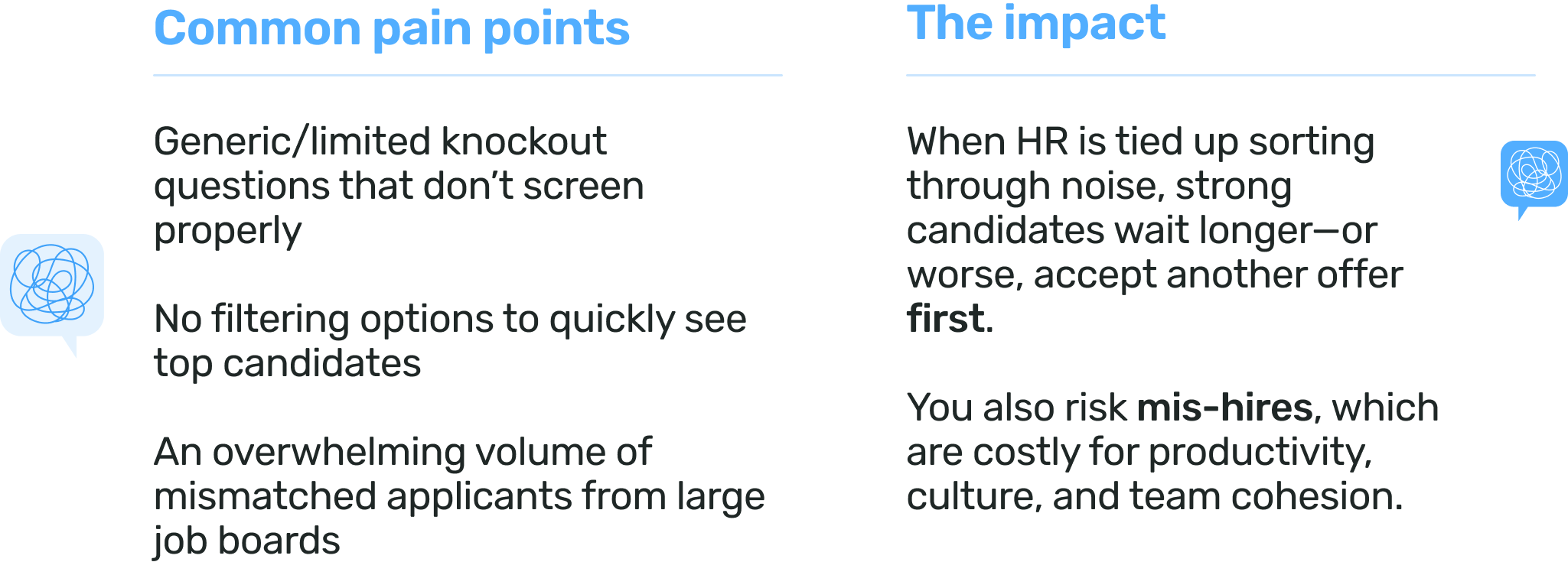
Ask any HR professional: sorting through unqualified applications is its own full-time job. Without role-specific screening questions or smart filters, teams end up spending more time eliminating candidates than selecting the right ones.
Job boards funnel in high volume, which sounds great on paper, but without the right screening tools, HR is left sifting through stacks of resumes that don’t match the role. It’s a frustrating experience; you’re spending hours eliminating candidates instead of elevating strong ones.
This mismatch usually starts at the top of the funnel. When your screening questions are generic—because your tools only allow for global knockout questions—you end up with a flood of mismatched applicants. HR teams then spend their time manually assessing candidates, delaying the process, and increasing the risk that great talent slips away. And when a rushed process leads to a mis-hire? That cost ripples through the team for months.
The goal isn’t more candidates—it’s better candidates. And without role-specific screening, better candidates are harder to find.
3. Limited reach = inconsistent applicant flow
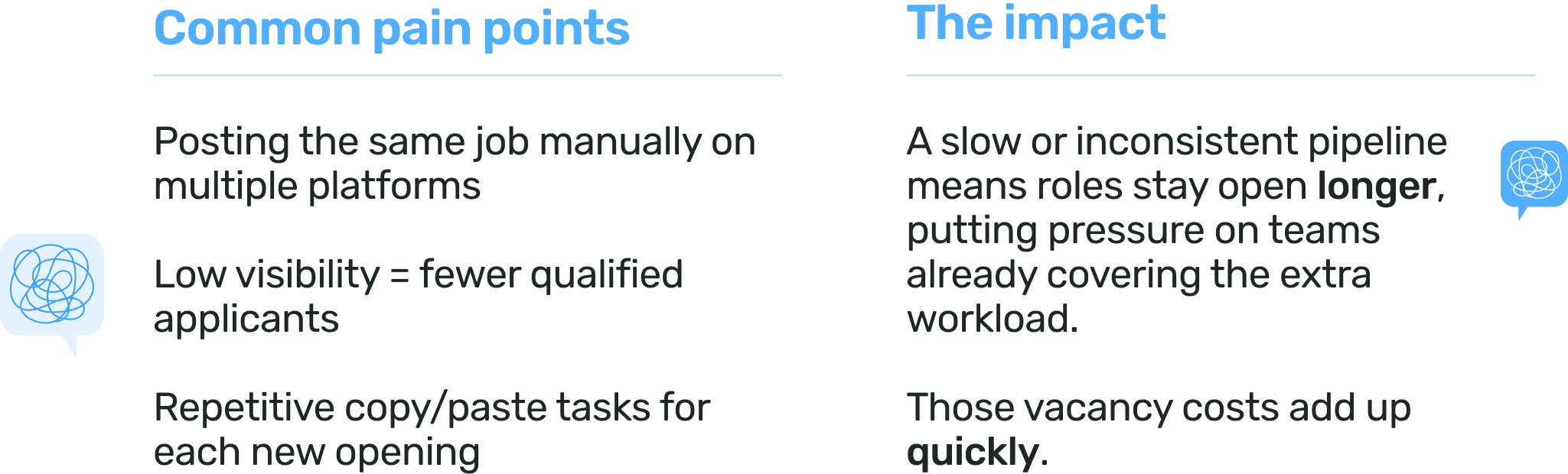
Smaller organizations don’t have the luxury of brand recognition that large enterprises do. As much as we’d like to think it doesn’t, visibility matters a lot. Without integrations to key job boards like Indeed and LinkedIn, recruiters spend extra time posting roles and often see fewer, lower-quality applicants as a result.
It’s already tough for smaller organizations to compete with large employers who have massive brand recognition and full-scale recruiting teams. When your job postings aren’t integrated with major platforms like Indeed or LinkedIn, that challenge becomes even sharper. HR teams often end up copying and pasting postings manually into each platform, which takes unnecessary time and still doesn’t guarantee strong visibility.
The result is a hiring pipeline that feels unpredictable—some months you get lucky, others you’re searching for qualified candidates while existing employees are stretched thin covering vacant roles. It’s stressful for HR and expensive for the organization.
A steady flow of qualified applicants is crucial for growth. Without tools that expand your reach automatically, you end up working harder for fewer results.
How modern ATS tools turn recruiting chaos into ROI
A modern ATS isn’t just a ‘nice-to-have.’ For growing organizations, it’s the difference between surviving and scaling. When hiring is slow, manual, and inconsistent, HR teams lose time, managers lose productivity, and the business loses momentum. But when the right tools are in place, hiring becomes faster, cheaper, and more strategic.
Below is how upgraded recruiting tech addresses the biggest hiring challenges and delivers measurable financial impact.
1. Cut time-to-hire by 30-50%
Most hiring delays aren’t caused by a lack of candidates; they’re caused by manual, repetitive steps that bog down HR and hiring managers. Modern automations remove that friction.
👉 A survey of more than 1,500 Canadian hiring managers found that 94% say the hiring process is slower than it was two years ago, citing longer application reviews, reference checks, and interview scheduling (Source).
With a modern ATS, posting a job becomes a single action that instantly distributes across your chosen job boards. That alone eliminates several hours of admin per role. Once candidates start applying, role-specific knockout questions filter out unqualified applicants automatically, reducing your initial screening volume by as much as 30–60%. And as candidates move through the funnel, a drag-and-drop Kanban view keeps everyone aligned. No more lost resumes, inconsistent notes, or manual status updates—just clear visibility and fast movement.
Financial impact of reducing your time-to-hire
If your HR coordinator saves just 10 hours per hire at ~$30/hour, that’s $300 saved per role. And by reducing time-to-fill by even five days, organizations often recoup $1,500–$2,500 in lost productivity. Multiply that across multiple roles per year, and the ROI becomes undeniable.
2. Reduce cost-per-hire by 20-40%
Hiring spend climbs quickly when HR teams need to compensate for inefficient processes. A modern ATS reverses that trend.
👉 The average cost of a bad hire is estimated at ~$17,000, factoring in productivity loss, onboarding, and re-hiring (Source).
Because job postings flow automatically to major platforms, teams rely less on expensive paid board placements. Automated screening means fewer unnecessary interviews, saving hours of hiring manager time. And with a stronger, more consistent candidate pipeline, companies can minimize or eliminate external recruiter usage altogether.
Financial impact of reducing your cost-per-hire
Avoiding even one external recruiter fee—typically $8K–$12K—can easily cover the cost of the ATS for the entire year. And with lower advertising spend and reduced interview time, cost-per-hire continues to drop across every open role.
3. Improving quality of new hires (and reducing turnover)
Turnover is one of the costliest consequences of poor hiring, and many of those mis-hires start with rushed or inconsistent screening. A modern ATS elevates hiring quality by standardizing the steps that matter most.
👉 24% of hiring managers admit they made a “bad hire” in the past two years, and 56% of those say it led to turnover (Source).
Role-specific knockout questions ensure that only candidates who meet essential criteria make it through the first gate. Evaluation templates keep interviews structured and fair, which dramatically improves both decision-making and compliance. And complete visibility across the funnel helps recruiters spot strong candidates earlier, before competitor offers come through.
Financial impact of improving the quality of new hires
Replacing a mis-hire can cost 1–1.5x the employee’s annual salary. Preventing even one mis-hire generates $40K–$70K in savings, making quality-of-hire improvements one of the most powerful ROI drivers an ATS can deliver.
4. Giving HR 100-300 hours back every year
Manual hiring tasks don’t just slow the process—they drain HR teams of the time they need for meaningful strategic work.
A modern ATS automates the tedious parts: posting jobs, updating candidate records, sending confirmations, scheduling interviews, and emailing status updates. Instead of juggling spreadsheets and inboxes, HR can manage everything in one place with dramatically fewer clicks.
Financial impact of giving HR more time back
Saving even 2–6 hours per week translates into $3,000–$9,000 in recovered HR capacity every year. That’s time that can be reinvested into onboarding, retention, engagement, DEI initiatives, and other high-value work that moves the organization forward.
5. Improving the candidate experience
Offer acceptance rates don’t just hinge on salary; they’re heavily influenced by speed, clarity, and professionalism. When candidates feel respected and informed throughout the process, they’re significantly more likely to say yes.
A modern ATS helps organizations respond quickly, communicate consistently, and eliminate unnecessary delays. Automated updates keep candidates engaged, while a clean, organized hiring flow presents a more polished employer brand. For smaller teams competing against larger employers, this can be the difference between landing top talent and losing them to a faster-moving competitor.
And for Canadian SMBs competing with well-known employers, a clean, modern applicant tracking system levels the playing field significantly.
Financial impact of a better candidate experience
Even a 5% increase in offer acceptance rates creates meaningful long-term value, especially for small and mid-size organizations where each hire has an outsized impact on productivity and culture.
Key takeaways: Building a business case for a modern ATS
When you’re preparing to pitch a new ATS solution to your leadership team, it helps to have a clear, concise summary of the value it brings. Modern recruiting tools aren’t just a convenience—they’re a strategic investment that can save time, reduce costs, and improve the quality of every hire. Keep these key points in mind as you make your case:

1. Manual recruiting processes aren’t sustainable
Old-school recruiting workflows—spreadsheets, endless email threads, manual screening—may have worked in the past, but today they’re a drain on your resources. These processes consume HR time, frustrate hiring managers, and leave candidates waiting. The longer roles sit open and the slower the process, the higher the hidden costs, including lost productivity, missed opportunities, and even damage to your employer brand.
2. A modern ATS reduces time-to-hire, improves candidate quality, and lowers cost-per-hire
Modern applicant tracking systems automate repetitive tasks like job postings, candidate screening, and interview scheduling. This not only accelerates your hiring timeline but also ensures that the candidates moving through your funnel are a better fit for the role. Fewer mis-hires, fewer wasted interviews, and less reliance on costly external recruiters all contribute to a measurable reduction in cost-per-hire.
3. HR teams can reclaim hundreds of hours annually
By eliminating manual tasks and streamlining workflows, HR teams gain valuable time back. These reclaimed hours aren’t just a convenience. They allow HR professionals to focus on strategic initiatives that drive real business impact, such as onboarding, employee engagement, retention programs, and diversity, equity, and inclusion efforts. Essentially, a modern ATS helps your team shift from administrative firefighting to strategic leadership.
4. Better tools create a better candidate experience, which leads to better hires
Candidates notice when hiring is disorganized. Automated communication, faster feedback, and smoother application processes create a professional, responsive experience. When candidates feel valued and informed, they’re more likely to accept offers, stay longer, and contribute meaningfully. Improving the candidate experience isn’t just good practice; it’s a direct lever for attracting and retaining top talent.
The bottom line
Outdated recruiting tools don’t just slow down HR—they silently drain budget, energy, and opportunity. For small and mid-sized organizations, these hidden costs can stack up quickly and impact growth in real, measurable ways.
Upgrading to a modern ATS helps you:
- Work faster
- Attract better talent
- Reduce turnover
- Save time and money
- Strengthen your employer brand
It’s not just a technology upgrade; it’s an investment in the people and processes that drive your organization forward.
Frequently asked questions
Is an ATS worth it for small businesses?
Absolutely—especially in Canada’s competitive hiring market. Even small HR teams can save hours per week by automating manual tasks like posting jobs, screening applicants, and scheduling interviews. A modern ATS improves candidate experience, keeps hiring compliant with Canadian HR and privacy standards, and helps you make better, faster hiring decisions. For small and mid-sized organizations looking to grow without adding recruiting headcount, an ATS quickly becomes a worthwhile investment.
How much does an ATS cost in Canada?
Canadian ATS pricing typically ranges from a couple of hundred dollars per month to several thousand annually, depending on features, number of employees, and hiring volume. Per employee, per month (PEPM) pricing models allow smaller teams to start affordably and scale up as their workforce expands.
What are the key benefits of an applicant tracking system?
An ATS helps Canadian employers streamline hiring and reduce the hidden costs of outdated processes. Top benefits include:
- Faster hiring with automated workflows and centralized communication
- Better candidate experience with easy applications, timely updates, and self-scheduling
- Improved quality of hires using structured screening and evaluation tools
- Lower hiring costs by reducing manual admin and improving job board performance
- Stronger compliance with Canadian privacy laws and record-keeping requirements
The result: more productive HR teams and a hiring process that attracts great talent, not headaches.
How long does it take to see a positive ROI for an applicant tracking system?
Most small and mid-sized Canadian organizations see clear ROI within the first few months of implementing an ATS. By reducing time to hire, eliminating duplicate tools, and minimizing costly recruiting delays, HR teams often recover the investment quickly. As adoption grows across hiring managers and recruiters, the long-term value compounds, resulting in lower turnover, better candidate pipelines, and stronger business results.
Additional Reading Links
- How HCM software enhances talent acquisition and recruitment
- How HR software helps growing companies scale effectively
- The top 4 HR workflows you should be automating right now
Ready to see the ROI for yourself?
Upgrade your hiring process today. Book a demo to see how Avanti Recruiter can transform your hiring from a burden into a competitive advantage.

Ready to see the ROI for yourself?
Upgrade your hiring process today. Book a demo to see how Avanti Recruiter can transform your hiring from a burden into a competitive advantage.