

Key Takeaways
- Manual resume screening doesn't scale, and the inconsistency and bias that creep in aren't edge cases; they're built into the process.
- Better screening starts before applications arrive. Agree on written criteria with your hiring manager before the role goes live.
- Structure beats intuition. A simple scoring rubric applied consistently will outperform a free-form read every time.
- An ATS isn't just for enterprise. There are affordable, fast-to-implement options built specifically for Canadian SMBs, like Avanti Recruiter.
- Get the process right first, then automate. The basics—centralized applications, defined stages, scorecards—deliver the most value with the least risk.
If you've ever posted a job and watched 200 applications land in your inbox over a weekend, you already know the feeling. That mix of flattery and dread. Someone has to read all of these.
At most small and mid-size organizations, that someone is you, or a colleague who also has a full plate of other work. And the tool you're using to manage it? Often just a spreadsheet and an email folder.
It's not a sustainable way to find good people. But it's also not your fault. Manual resume screening was not built to scale. Most HR teams at small and mid-size Canadian companies had no strong reason to change. That shifted when hiring volumes grew too high to manage.
That time comes for a lot of organizations. If these recruiting pains sound familiar, here's an honest look at what's going wrong and what actually helps.
The real problems with manual resume review
Volume is the obvious one
A single posting on Indeed or LinkedIn can generate hundreds of applications within days. Hiring managers at larger companies deal with this through sheer headcount. At a 50-person company, you don't have that. You have one HR generalist, maybe two, and a hiring manager who's already stretched thin.
Reading 300 resumes carefully takes time most teams don't have. So what happens instead? Reviewers start skimming. They make faster calls, and that's where things start to go sideways.
Inconsistency creeps in fast
When you're reviewing a stack manually, the 50th resume doesn't get the same attention as the fifth. By mid-afternoon on day two, you're skipping the cover letters. You're moving faster on resumes that look familiar because the format is easy to scan. You're unconsciously rewarding people who know how to write a resume over people who might actually be better at the job.
This isn't a character flaw. What happens when humans do repetitive cognitive work under time pressure is this. Consistency falls off.
The downstream effect: you end up with a shortlist that reflects who screened well on paper, not necessarily who would perform best in the role.
Bias—even when nobody's trying
Unconscious bias in resume screening is well-documented, and the research on it is uncomfortable reading. Studies have shown that identical resumes with different names receive different callback rates. Gaps in employment history trigger assumptions. Certain university names get attention while others don't—even when the candidate's skills are the same.
In Canada, this is particularly worth paying attention to given the diversity of our workforce. International credentials get undervalued. Names that “don't sound Canadian” face extra friction. These patterns exist even in organizations that value equity.
Manual review doesn't eliminate these patterns. If anything, it gives them more room to operate because there's no structure forcing reviewers to focus on what actually matters.
You can't track what you haven't measured
Here's a question worth sitting with: do you actually know how long your screening process takes from first application to shortlist? Do you know what percentage of the candidates you reject in screening go on to be hired by competitors? Do you know whether your screening criteria actually predict success in the role?
Most HR teams at smaller organizations can't answer any of those questions with data. No dashboard, no audit trail, and no way to spot patterns over time exist. Decisions get made, but they're not captured in a way that lets you learn from them.
What “better” actually looks like
The goal isn't to screen faster. To screen smarter—to spend less time on the wrong candidates and more time with the right ones. That requires a few things.
Clear, written criteria before you post the job
This may sound obvious, but it gets skipped constantly. If your team does not agree on what “qualified” means before applications arrive, each reviewer will define it differently. You'll end up with a shortlist that reflects whoever had the strongest opinions in the debrief meeting.
Before a role goes live, write down your must-haves (the things that actually qualify or disqualify someone), your nice-to-haves (things that differentiate candidates), and the things you explicitly don't want to weight too heavily (like credential prestige if it isn't actually relevant to the work).
Do it collaboratively with the hiring manager. It takes maybe an hour and saves a lot of frustration down the line.
Structured screening—same questions, same order, for everyone
One of the most effective things HR teams can do is move to a structured review process. That means every candidate is judged by the same criteria, in the same order. It is not a free-form review. Reviewers do not linger on what catches their eye.
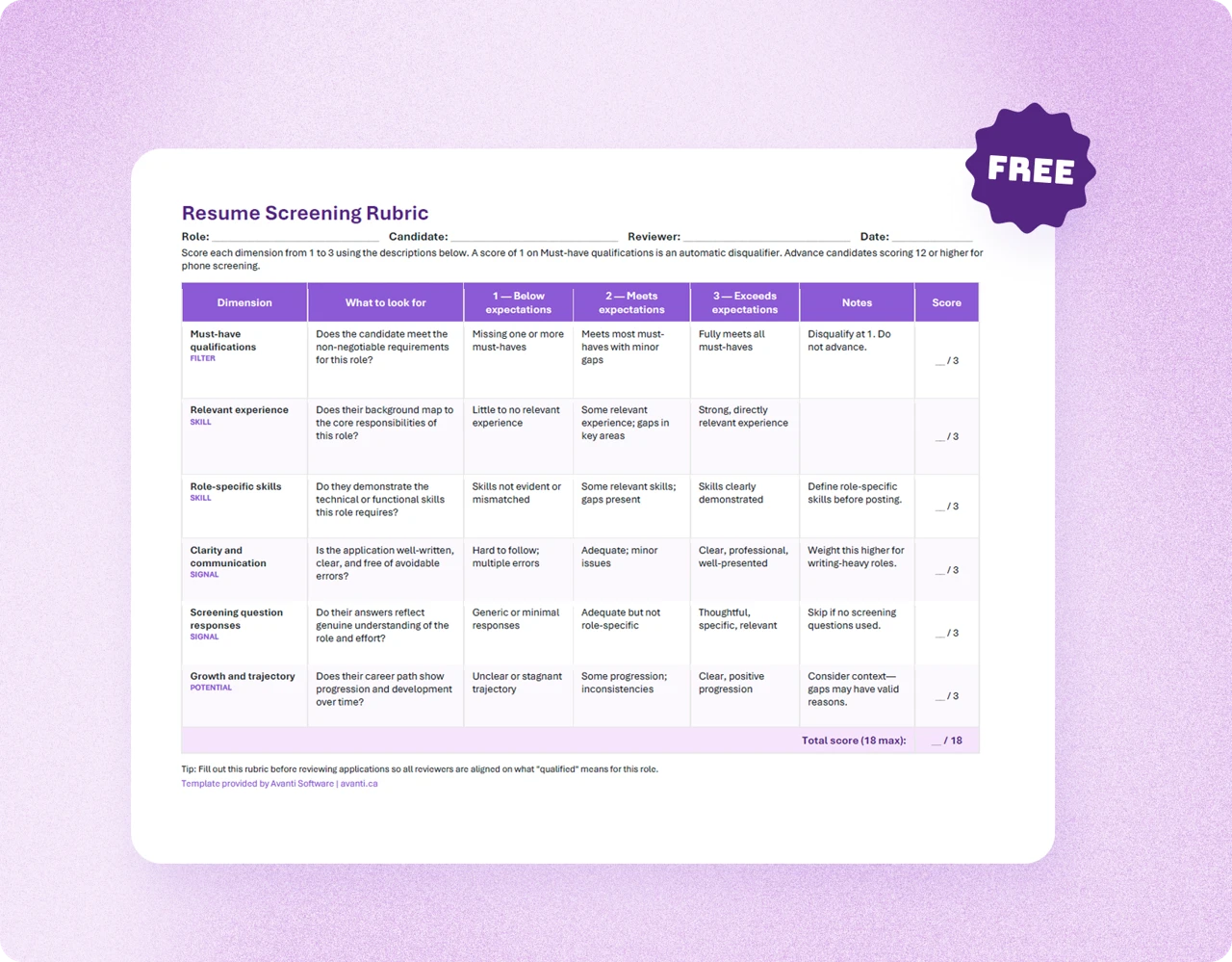
It doesn't have to be elaborate. A simple scoring rubric with five or six dimensions will do it. The point is to create a repeatable process that doesn't depend on reviewer intuition or energy levels.
Here’s a sample you can use. Download it here and customize it to meet your needs.
Earlier screening touchpoints that don't waste candidate time
A lot of organizations jump from application to phone screen to interview without any filtering in between. That puts a lot of weight on whoever does the phone screens, and it's hard to scale.
Short written screening questions—asked during or right after the application stage—can do a lot of the filtering work. Two or three targeted questions, specific to the role, will tell you more than most resumes will. Candidates who aren't serious or aren't a fit tend to self-select out. Those who are will usually put in the effort.
Where HR technology actually helps
An applicant tracking system isn’t a silver bullet. But for Canadian companies hiring more than a few people each year, it changes the math a lot.
Centralized, searchable applications
This alone is worth a lot. Instead of resumes scattered across email inboxes and shared drives, every application is in one place. Anyone involved in the hiring process can see the same thing. Notes and status updates are attached to the candidate record, not buried in a thread.
For small teams, the HR person, hiring manager, and sometimes a department head help screen candidates. This cuts down a surprising amount of back-and-forth.
.webp)
Configurable knockout questions
Most ATS platforms let you set up pre-screening questions that filter candidates based on basic requirements before a human reviews anything. Does this role require a specific licence or certification? Is the position on-site in a specific city? Are you looking for a minimum number of years in a particular function?
These aren’t about being harsh. They help ensure reviewers spend time on candidates who truly fit. When configured carefully, knockout questions can cut a 300-application stack in half before you've read a single resume.
.webp)
Consistent evaluation workflows
Good ATS platforms force a little structure. Review stages are defined. Scorecards are attached to requisitions. Reviewers have to make an explicit decision on each candidate rather than just leaving them in a pile.
That structure is what makes screening more consistent. Not perfect, since humans can be inconsistent, but better than a spreadsheet where each reviewer operates differently.
.webp)
Reporting that actually tells you something
Over time, an ATS gives you data on your own process. Time-to-screen, source of hire, drop-off points in the funnel, offer acceptance rates. For small organizations, that data becomes valuable faster than you'd expect. It tells you where your process is slow, where candidates are losing interest, and whether your screening criteria are working.
You can't improve what you don't measure, and you can't measure what's all in email.
.webp)
A note on AI-assisted screening
Some ATS platforms now offer AI-assisted resume parsing and ranking. It's worth being clear-eyed about this. These tools can be useful for initial sorting on objective criteria—years of experience, specific skills, location. They're less reliable for anything more nuanced, and they carry their own bias risks if not configured carefully.
If you’re considering AI screening features, choose platforms that explain how their ranking algorithms work. Make sure a human still decides who advances. Think of it as filtering down to a reviewable pile, not as a replacement for human judgment.
A realistic path for small teams
If your organization has a lean HR function and this all sounds like a lot, here's what a reasonable phased approach looks like:
Start with the process, not the technology. Define your screening criteria for current open roles. Build a simple scoring rubric in a spreadsheet. Get the hiring manager aligned before the job goes live. This costs nothing and will immediately improve the quality of your shortlist.
Then evaluate ATS options. There are solid, affordable platforms (like Avanti Recruiter) built specifically for small and mid-size organizations—options that don't require a six-month implementation or an enterprise contract. Many Canadian HR software vendors offer free trials. Use them. Focus on ease of adoption over feature count.
Add structure before automation. Get your team comfortable with a consistent workflow in the ATS before layering in any AI features. The basics—centralized applications, defined stages, scorecards—deliver the most value and the least risk.
The bottom line
Manual resume screening has real limits. Most HR teams at small Canadian organizations hit those limits sooner than they think. The problem isn't effort or intent. The process doesn't scale or stay consistent. It also doesn't produce the data you need to improve it.
A structured process and the right ATS won't make hiring easy. Hiring is hard, but they'll make it less chaotic and more defensible. It will also depend less on one person reading a stack of PDFs on a Tuesday afternoon.
That's a reasonable goal. And for most teams, it's more achievable than it looks.
Ready to modernize your screening process?
If this post resonated, it's probably because your current process has some of these cracks and you're not sure where to start.
Avanti builds recruitment tools for Canadian HR teams who need something that actually works at their scale. No six-month implementation. No enterprise contract. Just a cleaner, more consistent way to move from posting to shortlist.
Additional reading links
- The hidden costs of outdated recruiting tools and how to fix them
- 8 steps for hiring without bias
- ATS Buyer’s Guide
Frequently asked questions
What is resume screening, and why does it matter?
Resume screening is the process of reviewing job applications. It helps identify candidates who meet the minimum role requirements. Qualified candidates can then move on to the interview stage. It matters because it's the first filter in your hiring funnel. Done well, it saves significant time and surfaces stronger candidates; done poorly, it introduces inconsistency, bias, and missed hires. For small and mid-size organizations with limited HR capacity, an effective screening process is one of the highest-leverage places to improve hiring outcomes.
How long should resume screening take?
There is no one answer. A useful benchmark is five to ten minutes per application for an initial review. If it's consistently taking longer, that's often a sign that the role's criteria aren't clearly defined upfront, or that reviewers are compensating for a lack of structure with more deliberation. Pre-screening questions and knockout filters in an ATS can bring initial triage time down significantly, so that deeper review time is reserved for genuinely qualified candidates.
What should you look for when screening resumes?
Focus on criteria directly tied to job performance, not on proxies like university prestige or resume formatting. Before screening begins, your team should agree on the must-haves (non-negotiable qualifications), the nice-to-haves (differentiators), and what you're explicitly not going to weight. Relevant experience, specific skills or credentials required for the role, and demonstrated progression in similar functions are generally more predictive than educational pedigree or aesthetic presentation.
What is an applicant tracking system (ATS), and do small businesses need one?
An applicant tracking system (ATS) is software that centralises job applications, automates parts of the screening process, and helps hiring teams manage candidates through defined stages. Small businesses often assume an ATS is only for enterprise HR teams, but that's changed considerably. There are now platforms built specifically for organizations with 20 to 500 employees that are affordable, fast to implement, and don't require a dedicated HR tech administrator. If your organization is making more than a dozen hires per year or struggling with volume, consistency, or audit trails, an ATS is worth evaluating.
How can you reduce bias in resume screening?
The most effective structural interventions are: defining your screening criteria in writing before reviewing any applications; using a consistent scoring rubric so every candidate is evaluated against the same dimensions; and limiting the influence of information that isn't predictive of job performance (educational brand, employment gaps, names). Some organizations also use blind screening—removing identifying information before review—though this works better in combination with structured criteria than as a standalone fix. An ATS helps by building structure into the process itself, rather than relying on individual reviewers to maintain it.
What are knockout questions, and how should you use them?
Knockout questions are pre-screening questions added to a job application that automatically filter out candidates who don't meet a hard requirement, such as holding a required licence, being eligible to work in Canada, or being available for a specific work arrangement. They should be used sparingly and only for true disqualifiers: requirements where a "no" answer genuinely means the candidate can't do the job. Using them too aggressively risks filtering out good candidates on technicalities. Used well, they can significantly reduce the volume of applications that require human review.
What's the difference between structured and unstructured resume screening?
Unstructured screening means each reviewer approaches applications differently, reading what catches their eye, weighing factors based on personal intuition, and making judgment calls without a consistent framework. Structured screening means every candidate is evaluated against the same predefined criteria, in the same order, using a scoring rubric. Research consistently shows that structured processes produce more consistent, less biased shortlists. They also make it easier to defend hiring decisions and identify patterns over time.
See Avanti Recruiter in action
Get a walkthrough of how our ATS helps small and mid-size teams manage applications, automate screening, and keep hiring moving.

See Avanti Recruiter in action
Get a walkthrough of how our ATS helps small and mid-size teams manage applications, automate screening, and keep hiring moving.

.png)